Thursday, May 01, 2014

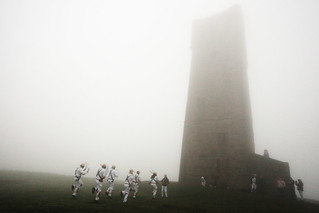
May day


May day morn
 Castle Hill c5.30am, 1 May 2014.

Labels: , ,

Monday, October 05, 2009

Ghost streets in the sky

Tha knows (by tim2ubh)
I'd been meaning to get up to Sheffield's Park Hill estate for a year or more, since first seeing the vast wall of hollowed-out flats while driving by Ponds Forge beneath. There wasn't any great rush - according to recent reports in the Sheffield Star, the project (estimated cost £160m) won't be complete till around 2017. It's three and a half years since I wrote about the plans here.

I had a free morning in Sheff last Friday, so popped over. I think it's the first time I'd actually been up close to the place - looming over the city like some demon fortress, it had a fearsome (and mostly undeserved) reputation when I was growing up in the city.

On the slide (by tim2ubh)

If it's still an unnerving place, it's an environment of eerie solitude rather than one of social threat, like stepping into the partially autopsied carcass of some sprawling municipal beast. Part has been stripped back to the concrete skeleton, secured behind high steel fencing; but the bulk has just been emptied and shuttered, and you're free to walk at will. All seemed deserted, although parts of the upper estate are still inhabited.

Stages (by tim2ubh)

It's an interesting place to visit at the moment. I've doubts whether Urban Splash's grand plans will ever come to fruition, or whether this unique building will disappear from Sheffield's skyline. But the stripped frames of this first phase seem to hold a strange promise, of brutalism turned gothic, the bones of some monster waiting to be reborn.

Dead heads (by tim2ubh)

Labels: , ,

Wednesday, August 12, 2009

Doctor King's houses of horror

I've just been reading, somewhat belatedly, Jonathan Coe's very enjoyable state-of-the-(1980s)-nation gothic satire 'What a Carve Up!'. In his author's note at the end of the book, Coe notes his 'shadowy debt' to the works of Frank King, author of 'The Ghoul' (1928), on which the 1960 movie (from which Coe took his title and elements of plot) was loosely based. Coe also says that he had been unable to trace any information on King, whose bibliography also includes such thrilling titles as 'Terror at Staups House', 'This Doll is Dangerous', 'Death of a Cloven Hoof' and 'Only Half the Doctor Died'.

This immediately tickled a memory. Last year, the Halifax Courier published this story, based on research by local historian David Glover, on the life of what it calls one of the town's famous yet perhaps forgotten sons. Frank King was indeed born in Halifax in 1892 - just a few streets away from my house, in fact - worked as a doctor in the town before quitting to write full-time (something rather appropriate to Coe's book), and died in 1958 just out at Norton Tower.

Intriguingly, King was likely to have been writing at his offices in Rhodes Street at the time the Halifax Slasher panic struck the immediate neighbourhood.

If anyone is in touch with Coe, please do let him know.

Labels: ,

Friday, June 12, 2009

Bradford, city of film

Congratulations to Bradford for being named as the first Unesco City of Film. It's been a while coming (the bidding started back when I was writing for Yorkshire Insider regularly, if I remember right), and it might be hard to entirely grasp the logic of it, but good for them.

The city's proud Telegraph & Argus has a solid write-up (with some hilariously fruitbat comments), and the same paper's David Barnett bigs it up further in a Guardian blog.

I was going to link to the wonderful 'Every sperm is sacred' section of Monty Python's the Meaning of Life here, which I always thought was filmed in Bradford, but a bit of research finds that it was actually mostly filmed over in Colne...

Labels:

Tuesday, June 09, 2009

Proper wuthering

Ogden (by tim2ubh)
Lovely piece from Martin Wainwright in the the walks supplement with today's Guardian, in which he rhapsodises about the wuthering beauty of Ogden Water and Ovenden Moor, wind farm and all, just north of Halifax (described, rather curiously, as a 'market town' - while there is a great indoor market, I'd say it's still a classic mill town).

There's also directions for the walk, which I've been round a few times myself.

Labels: , ,

Friday, February 20, 2009

Crisp news

The Business Desk brings good news combining two of my abiding interests - Yorkshireness and savoury snacks.
Yorkshire Crisps, based in Wales (the one just the other side of Sheffield, that is), has won a distribution deal with Sainsburys. Best of all, the deal includes their new Henderson's Yorkshire Sauce flavour, based on that immortal relish brewed just across the street from where I was born. I had a pack yesterday, and they're very tasty indeed. A fair bit classier than Seabrook's, they're probably better suited to munching with a glass of chilled wine from Leventhorpe than with the traditional pint. Mmm.

Labels: ,

Monday, February 02, 2009

White out

Cossack (by tim2ubh)

Bit snowy round our way today.

Labels: ,

Thursday, December 11, 2008

The Road to Huddersfield

Sometimes, a good poke around a secondhand bookshop will turn up something that just leaps off the shelf at you. So it was with 'The Road to Huddersfield: A Journey to Five Continents'. A book commissioned by the World Bank from Guardian journalist James (later Jan) Morris in the early 1960s, with a delightfully Yorkshire-centric title - what's not to like?

Huddersfield here is posited as the exemplar of industrialised society, the epitome of 20th century civilisation, the very birthplace of the modern world, whose 'horny, stocky, taciturn people were the first to live by chemical energies, by steam, cogs, iron and engine grease, and the first in modern times to demonstrate the dynamism of the human condition'. Aye, that's right enough.

The assigned task of the World Bank was then (and, more or less, is now) to help those less advanced nations advance along the titular road to Huddersfield - to fund those infrastructure projects which, according to theory, will speed those economies towards the wealth and freedom from want of industrial society, that very state of Huddersfieldness.

After a visit to the World Bank HQ, under the idiosyncratic rule of Eugene Black, Morris travels through some of the recipients of the Bank's aid - Ethiopia, Siam, southern Italy, Colombia, and the Indian-Pakistani borders - in an elegant and picturesque odyssey. Given that the book was commissioned by the Bank, Morris stays remarkably ambiguous about the effects and efficacy of its work - a lot kinder than many of its latter-day (or even contemporary) critics, but no apologist for its occasional incompetence or amorality.

Some 45 years on, some of the descriptions of the countries visited strike a little odd. 'Nobody is starving' in Ethopia, though that country 'is still a long, long way from Huddersfield'. Further East, 'it is no coincidence that Burma, that gilded stronghold of Buddhism, is perhaps the only country on earth that shows no eagerness at all to take the Huddersfield Road." On the other hand, the chapter detailing political and ethnic tensions in the Indus basin seems ever relevant - though some might see a certain irony as Morris notes of Pakistan, 'never did a country seem to need her Huddersfield more.'

It all makes for an intriguing slice of political and economic history. Although it seems slightly unfair that the book's thin section of photographic plates does not show the titular Yorkshire town, but rather its neighbour Halifax - a view from Beacon Hill of a near-unrecognisable forest of belching chimneys. Were it not for the dark satanic smog, now long gone, you might just see my house from there.

Labels: , , ,

Friday, September 19, 2008

Bish bash HBOS


A worrying time for my home town of Halifax, with a significant number of local jobs sure to disappear in the wake of Lloyds' white knight takeover of HBOS. Exact numbers have yet to be announced, but I'd guess at least a thousand in the town - maybe more.

Lloyds has said that preserving jobs in Scotland will be a priority - job losses there were also small when the Halifax acquired the Bank of Scotland back in 2001, with most of the limited cutting then done at lower levels, and Edinburgh also had the honour of hosting the head office at the BoS's historic HQ on the Mound. So saving jobs there seems fair enough - the Guardian reports that the group has 6,459 employees in Edinburgh, a fairly significant chunk of well-paid employment in a city of 450,000.

But what's worrying is that nothing's been said about jobs in the Halifax' eponymous home. HBOS also employs around 6,500 in and around Halifax - and this is a town of just 90,000, with far fewer other major industries than the Scottish capital.

There are obvious political motives for favouring Scotland, which will put Labour into even more disfavour locally. Fair enough, most will say.

But the potential economic impact on the town and the surrounding area is likely to be terrible. The presence of the bank here - its head office until the BoS takeover and, after, the base of the expanded retail operations - has been the main factor in protecting the town from the worst of the industrial decline and saved it from being quite as bad as, say, Burnley. Any major reduction of HBOS employment would, alongside the general downturn, easily make it as bad as, say, Barnsley when the mines were closed. Not a happy prospect.

It might not be that bad, of course. There's inevitably going to be swingeing cuts at the common operations of the two merged groups, but it's a question of deciding how that's going to be split between Lloyds and HBOS. I'm less familiar with Lloyds' operations, but I'd guess the bulk of their operations are in London. It might then be an attractive option for them to cut jobs in that more expensive employment market, and keep them in the more cost-effective West Riding.

But even if that happens, I'd guess that in Halifax they'll be cutting from the top; and in London, from the bottom. Fewer well-paid, professional jobs here in finance, IT, management and so forth, but we'll likely still get the minimum-wage call centre and data input end. Not a great deal.

More generally, it's been fun to see the scrabbling for scapegoats to blame for the deeply shite state of the banking markets, and the faux outrage over the antics of the short-sellers and speculators who we are shocked (shocked!) to find are inclined towards amoral profit-seeking based on some rather unrealistic financial models. At least, I hope it's faux - surely no one who's been keeping the vaguest of eyes on the financial markets and the economic orthodoxy can honestly be remotely surprised?

As per the title of this blog (borrowed from Galbraith, of course), it looks like reality has caught up with its would-be escapees.

Labels: , ,

Wednesday, September 17, 2008

The Invention of Yorkshireness

Congratulations to William Marshall, curmudgeonly columnist on the Halifax Evening Courier, on securing a grant to research a topic close to my heart - 'The Invention of Yorkshireness: Yorkshire cultural identities 1850-1914'.

The Yorkshire Post quotes Marshall on that noble creed 'See all, hear all, say nowt; eat all, drink all, pay nowt' -
"It's interesting to discover the ways in which Yorkshire people have come to define themselves like this.
"One area of source material I've been looking at is picture postcards from the early 1900s. There's a series of "Yorkshire Sayings" which depict pot-bellied farmers dispensing such advice as a mother telling her daughter to only marry for money or a father telling his son never to do anything for 'nowt'.
"The thing is, these stereotypes actually seem to have been taken up by Yorkshire people themselves.
"They seemed to relish this idea of being quite stubborn and selfish – many of these postcards were bought by Yorkshire-folk and sent to other people within the county, so this negative self-image was not only acceptable to them but perpetuated by them."


More in the Courier itself, although that paper does show some distressing regional stereotyping in its headline: Our William is given an 'Ey oop' award.

On a related subject, I'm quite pleased with this panoramic pic I did of Halifax as seen from Beacon Hill -
Halifax, in all its glory
Click through for full-size, to admire the town's geographic and architectural glories - given the financial news of the past few days, it could be a last chance to see the HBOS head office before they put the shutters up...

Labels:

Sunday, August 24, 2008

Tinsley towers no more

The end of an era last night, as the twin cooling towers by Tinsley viaduct in Sheffield were (mostly) brought down at the suitably ungodly hour of 3am. The BBC has film of the demolition, while my Flickr chum Wsogmm has the best photo I've seen so far.

So what now? The hopes for some iconic piece of public art for the site seem to have come to nowt. Site owners E.On have said they'll sponsor some art on the theme of 'energy', but not necessarily at Tinsley. Plans for a biomass power plant for the site are still go, as far as I know.

In the meantime, the landscape's got that little bit less interesting.

Labels:

Monday, June 23, 2008

Broken blades

Regular readers will know about the long and thorny saga behind the new wind turbines at the University of Sheffield's Advanced Manufacturing Research Centre. The two turbines have been up for a couple of months now, and have become something of a landmark on the M1 and Sheffield Parkway.

Regular commuters might have noticed something a little different this morning, however.
Broken blade

One of the turbines suffered damage to both blades during yesterday's 'rare summer gales'. As is now rather obvious, one broke clean off.

From the AMRC statement:
One of the AMRC's wind turbines suffered a failure dring the extreme weather conditions this evening.
Prior to the blade failure, engineers were on site monitoring the situation and ensuring the safety of workers and the general public. Police were informed and diverted traffic.
An investigation is now underway by the manufacturers - Wind Energy Solutions (www.windenergysolutions.nl) - any enquiries should be directed to them.


Broken blade 2

On the face of it, it's not the best advert for the centre's high-tech materials and engineering expertise. But the turbines were bought in as complete units, so its hardly the ARMC's fault. Although really, that shouldn't happen to what is now a pretty well established technology...

Labels: ,

Tuesday, June 17, 2008

Top ten mills

Great piece in the Guardian - West Yorkshire's top ten mill conversions.

Salt's over Dean Clough? That'll cause ruptions...

Labels: ,

Tuesday, April 22, 2008

Grounded

The Sheffield Star marks what is probably the last flight from the city's airport, with a look back at its troubled history.

Meanwhile, steel boss Andrew Cook has stepped up as the erstwhile mystery backer of the save-the-airport lobby (Sheffield City Airport Movement, aka SCAM), which is still chasing the legal route:
They are then hoping for a full court hearing to consider whether owner Peel Airports and Sheffield Council abided by conditions which stated the airport - which opened in 1997 - had to be kept operational for 10 years and "all reasonable efforts" had to be made to attract airlines.
Mr Cook said: "The reason I am doing this is because I think it borders on madness for a city the size of Sheffield to give up its airport without a fight.
"I think it is an abomination that something that should be regarded as a valuable municipal facility should be thrown away."

Labels: ,

Thursday, April 03, 2008

Sheffield malarkey latest

Updates on a couple of long-running Sheffield development stories -

Alexandra Topping reports in the Guardian on the doomed battle to preserve the Tinsley towers, or at least to erect some meaningful public art in their place:
The Tinsley cooling towers - bleak, elegant, real - are often the first and last thing people see as they enter and leave the city. But soon, like Sheffield's industrial golden age, they will be consigned to history, demolished to make way for a new power station. [Tom James of the Go magazine] reflects: "Imagine, when the towers are gone, Meadowhall will be the only thing you'll be able to see from the tram and the M1. How depressing."

And I hear there's much discontent, in some fairly high-up places, about the Peel Group's controversial purchase and closure of Sheffield City Airport. While it's probably too late for Sheffield, the group's finding its proposed plans elsewhere are undergoing a bit more scrutiny than they're used to. Not much substantiated at the moment, but could be worth looking into...

Labels: ,

Monday, March 24, 2008

Pace Egg play


On Friday (Good Friday, that is), we took ourselves up to Heptonstall for the first of the day's performances of the Pace Egg Play. The play's been traced back to the 1500s or so, but the obvious pagan roots suggest rather older roots. The current version has just been running since 1979 but, as this BBC story from last year relates, it's as close to the old play as possible given the effects of time and memory.

It's a rollicking performance, anyway. Many of the towns and villages on both sides of the Pennines have their own version, performed at Easter or new year, but Heptonstall's is reckoned to be one of the best in the 'combat' mode of the play.

More pics of the action over on my Flickr page.

(Apologies for the lack of recent action on this blog, by the way - I've been tied up recently on a contract with the Environment Agency, but the (un)usual service should be resumed soonish.)

Labels: , ,

Friday, February 08, 2008

Airport Peeled, discarded

Today's Sheffield Star brings the hardly unexpected confirmation that the city's airport is to close, due to 'sustained losses' incurred after owner Peel Airport's decision to pretty much close it down anyway. This appears to demonstrate that the site is not commercially viable, allowing Peel to snap up the land and facilities for a quid (estimated value, according to sources quoted in the Star: £440m).

As previously noted, Peel used the proximity of the airport to block the construction of a 90m wind turbine alongside the Factory of the Future building on the nearby Advanced Manufacturing Park (the FoF, now just about ready for occupancy, instead settled on two 56m turbines, awaiting erection). Peel has subsequently announced plans to install showpiece turbines at its Liverpool airport:
The wind turbines will potentially, along with other renewable energy sources, play an important part in the airport's future development. This trial will hopefully demonstrate that turbines can be sited at an operational airport and that others can follow suit.
Funny, that.

Labels: ,

Thursday, October 25, 2007

Balls for Tinsley

Yesterday's 150th anniversary of the world's first football club links inevitably to another Sheffield obsession - how to replace those much-loved Tinsley towers.
This thing pictured here (image copyright unknown) is, according to the Star, the proposal from local MP Richard Caborn. Got to say, think I preferred the winning design from the actual RIBA competition.

Labels:

Wednesday, October 24, 2007

Football, another Sheffield invention

I'm not much of one for football, but the 150th anniversary of Sheffield FC can't be ignored. The world's first football club, Sheffield basically set the rules for the FA and created the modern globalised game. That the beautiful game was made in Sheffield is probably the one footballing fact that both Blades and Owls have ever agreed on.

And personally, I'm very glad to settle one question I've always wondered about - if they were the first team, who did they play against?
Members organised themselves into teams for matches such as Married Men versus Unmarried Men, and Professional Occupations versus The Rest, apparently.

The anniversary celebrations also mean that the club's current fixtures list reads a little differently:
Grantham Town
Spalding United
Stocksbridge Park Steels
Inter Milan FC
Carlton Town

Labels: ,

Monday, October 08, 2007

Halifax's knockout Nobel

Congratulations to Oliver Smithies, joint winner of this year's Nobel Prize in medicine. Along with Mario Capecchi and Martin Evans, Smithies wins the prize for helping develop the 'knockout' technique for using embryonic stem cells in genetic modification - a technique that remains rather controversial in some areas.

Science and controversy aside, the (entirely parochial) interest here is that Smithies was born here in Halifax, and educated at the former Heath Grammar School just down the hill from me. That makes him, as far as I can tell, Halifax's first Nobel Laureate. Not the first for Calderdale though - Todmorden has John Cockcroft (Physics, 1951) and Geoffrey Wilkinson (Chemistry, 1973) to its credit. Not too bad for a small Pennine borough that doesn't even have a university.

Labels: ,